Private AI Versus Public AI: What Fits Your Business?
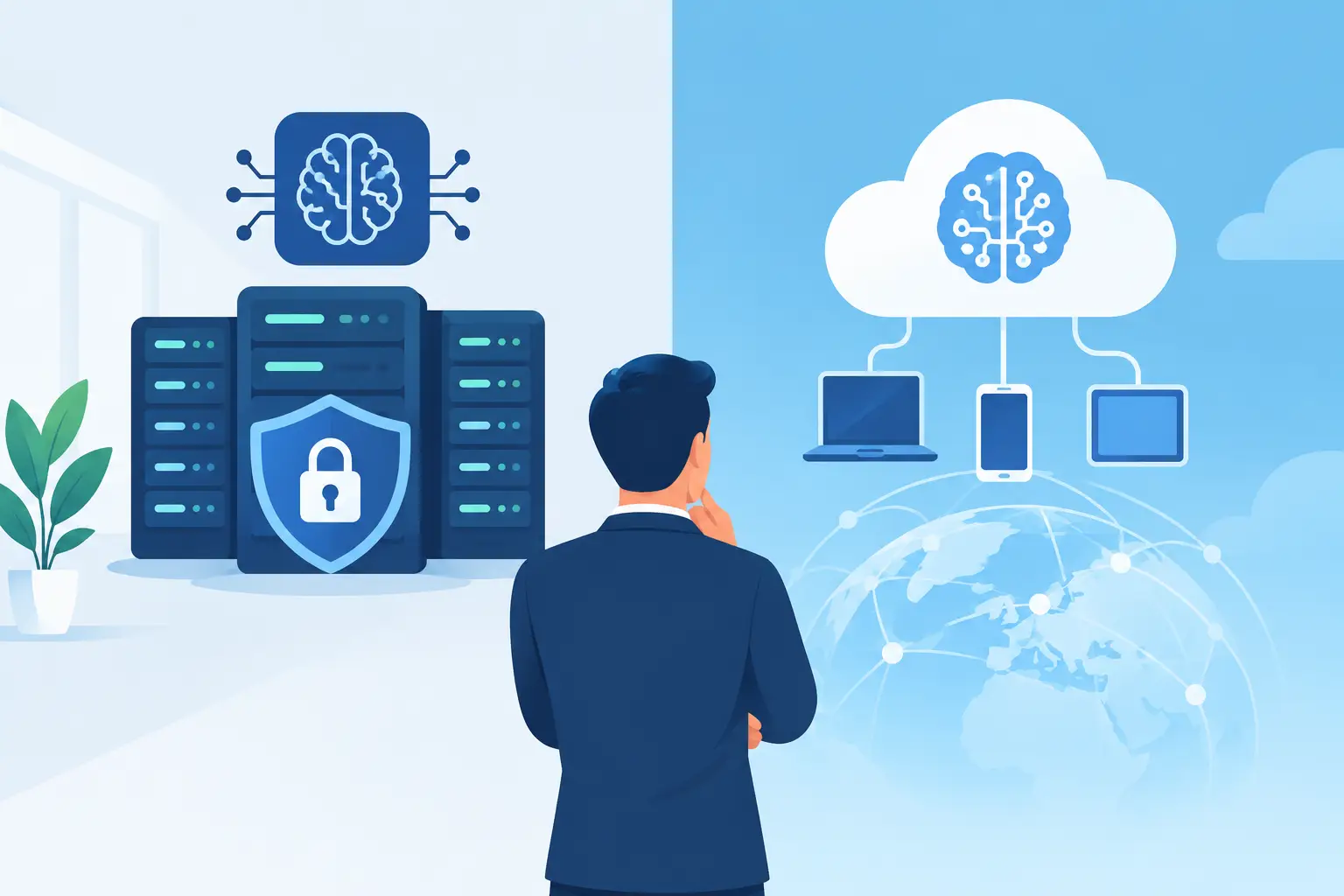
A team member pastes a client email, a patient note, a contract clause, or next quarter's forecast into a public AI chatbot to save 10 minutes. That simple moment is where the private AI versus public AI decision becomes real. It is not primarily a technology debate. It is a decision about what information leaves your control, how work gets done, and whether an AI tool can be trusted inside a business process.
For Canadian organizations, the stakes are often higher than the average software comparison suggests. Privacy obligations, customer expectations, data residency requirements, professional duties, and existing security policies all shape the answer. The right model is rarely "public only" or "private only." It depends on the use case, the data involved, and the controls surrounding it.
What public AI actually means
Public AI usually refers to broadly available AI services accessed through a website, consumer app, or general business subscription. These tools can be exceptionally useful for low-risk work: drafting a first-pass job description, brainstorming campaign concepts, summarizing public research, or improving the clarity of a document that contains no sensitive information.
Their advantage is speed. Employees can begin experimenting in minutes, without a major technical project or infrastructure investment. That accessibility explains why public generative AI has spread quickly through Canadian workplaces, often before leadership has agreed on approved tools or written clear rules.
The limitation is that a public interface is not the same as a controlled business system. Terms, retention settings, training policies, account permissions, and data locations vary by provider and subscription level. Even where a provider offers strong enterprise commitments, a business still needs to configure the service properly, decide who can use it, and establish what information is permitted.
A public AI tool can be a sensible part of an AI program. It should not become an ungoverned shortcut around security, records management, or human review.
What private AI means in practice
Private AI describes AI capabilities designed for a specific organization and operated with stronger control over data, access, integrations, and governance. It does not always mean building a foundation model from scratch or running every component on servers in your own office. For most businesses, that would be expensive and unnecessary.
More commonly, private AI means a solution that connects approved models to your internal knowledge, systems, and workflows under defined security controls. It may use a dedicated cloud environment, a private tenant, a Canadian data region where available, or a carefully configured enterprise platform. The distinguishing feature is not a marketing label. It is the operating model.
A private AI assistant might help a service team find answers across approved policy documents, generate a draft response in a CRM, and route unusual cases to a manager. A manufacturing application might extract information from quality reports and flag recurring issues. A legal or financial services workflow might summarize documents while maintaining role-based access and a documented review step.
The goal is practical: bring AI to the work while keeping the right boundaries around information and decisions.
Private AI versus public AI: the business trade-offs
Public AI is usually faster to access and easier to test. Private AI usually requires more upfront discovery, solution design, integration, and governance. Treating that additional effort as a drawback misses the point. For a meaningful operational use case, the work is what turns an impressive demo into a dependable capability.
Data sensitivity and privacy
This is often the first decision filter. If a task involves personal information, confidential client material, employee records, proprietary pricing, financial data, health information, legal advice, or internal strategy, a consumer-grade public tool is rarely an appropriate default.
PIPEDA and provincial privacy requirements do not provide a simple checkbox for AI. Organizations remain accountable for how personal information is collected, used, safeguarded, and disclosed. A vendor's security claims do not remove that accountability. Businesses need to understand data flows, retention, access, contractual protections, and whether information crosses borders.
That does not mean every sensitive use case demands a fully self-hosted model. It means controls must match the risk. A private, properly configured deployment may be suitable where a public chat interface is not.
Speed versus workflow value
A public tool can produce immediate individual productivity gains. That is valuable, especially when employees are learning where AI can remove repetitive work. But the value often remains inconsistent and hard to measure because the work happens outside core systems.
Private AI takes longer because it is built around a process. It can retrieve approved information, respect user roles, write back to business systems, trigger an approval, and create an audit trail. Those capabilities make it more useful for repeatable tasks such as intake, document processing, service triage, internal knowledge support, and reporting.
The question is not whether a chatbot can answer a prompt. The question is whether the solution reduces cycle time, errors, rework, or administrative burden in a process that matters.
Cost and ownership
Public AI has a low entry cost, but organizations should account for the hidden expense of fragmented usage: duplicate subscriptions, untracked data handling, inconsistent outputs, employee time spent recreating work, and the cost of correcting mistakes.
Private AI has higher implementation costs because it requires process mapping, integration, testing, security design, and change management. It also needs ongoing monitoring as models, source data, and business rules change. In return, it can create a more durable asset: a governed workflow that becomes part of how the organization operates.
For a small number of occasional, low-risk tasks, public AI may be the commercially sensible choice. For high-volume or high-consequence work, private AI can justify its cost through measurable operational outcomes.
Accuracy, accountability, and human judgment
Neither private nor public AI is automatically accurate. Both can produce incorrect, incomplete, or overly confident answers. The difference is that a private solution can be designed to narrow its source material, cite internal references, enforce business rules, and place a person at the right approval point.
Human review should not be treated as proof that an AI deployment has failed. In areas involving customer commitments, regulatory obligations, hiring, health, safety, payments, or legal interpretation, human judgment is the control that keeps automation useful and accountable.
The best designs remove the repetitive preparation work while preserving the decisions that require experience, context, and relationships.
A practical way to choose the right model
Start with the process, not the tool. Identify where people spend time locating information, rekeying data, sorting requests, preparing standard documents, or responding to repeat questions. Then assess the data involved, the consequence of an incorrect output, and the systems the AI would need to access.
A useful decision sequence has three stages.
Discover the use case and its boundaries
Document the current workflow, including inputs, exceptions, approval points, and pain points. Classify the information involved and define what must never be entered into an unapproved tool. This is also the stage to identify data residency expectations, retention requirements, and the teams responsible for privacy, security, and operations.
Build for the required level of control
Choose the simplest architecture that meets the need. A low-risk drafting task may need an approved enterprise public AI account and a clear acceptable-use policy. A client-facing assistant or internal knowledge agent may need private retrieval, role-based access, system integration, logging, and human escalation.
Avoid overbuilding. A private model hosted entirely in-house is not automatically better if it adds cost and complexity without reducing a real risk. Equally, avoid underbuilding an operational tool simply because a public chatbot is convenient.
Adapt through measurement and governance
After deployment, measure adoption and business outcomes. Track time saved, escalation rates, response quality, error patterns, and user feedback. Review source content, permissions, and model behaviour regularly. Governance is not a policy document filed away after launch. It is an operating practice that evolves with the use case.
The model matters less than the discipline
Many organizations frame the choice as private AI for security or public AI for innovation. That is too simplistic. An unmanaged private system can still expose data or produce poor outcomes. A well-governed public enterprise tool can safely support useful low-risk work.
The stronger distinction is between accidental adoption and intentional deployment. Accidental adoption leaves employees to decide what is safe, useful, and accurate on their own. Intentional deployment gives them approved tools, clear boundaries, training, and workflows that make the better choice easier.
For businesses moving beyond experimentation, this is where an execution-led approach matters. The work is not finished when a platform is selected or a policy is published. It is finished when employees can use AI confidently in a real process, sensitive information is handled appropriately, and the organization can point to a measurable improvement.
The most useful next step is to select one process where repetitive effort and information friction are high, then design the level of AI privacy and control around that process. That creates a decision grounded in business reality, not fear of the technology or enthusiasm for its latest demo.