AI Governance That Lets Your Business Move Faster
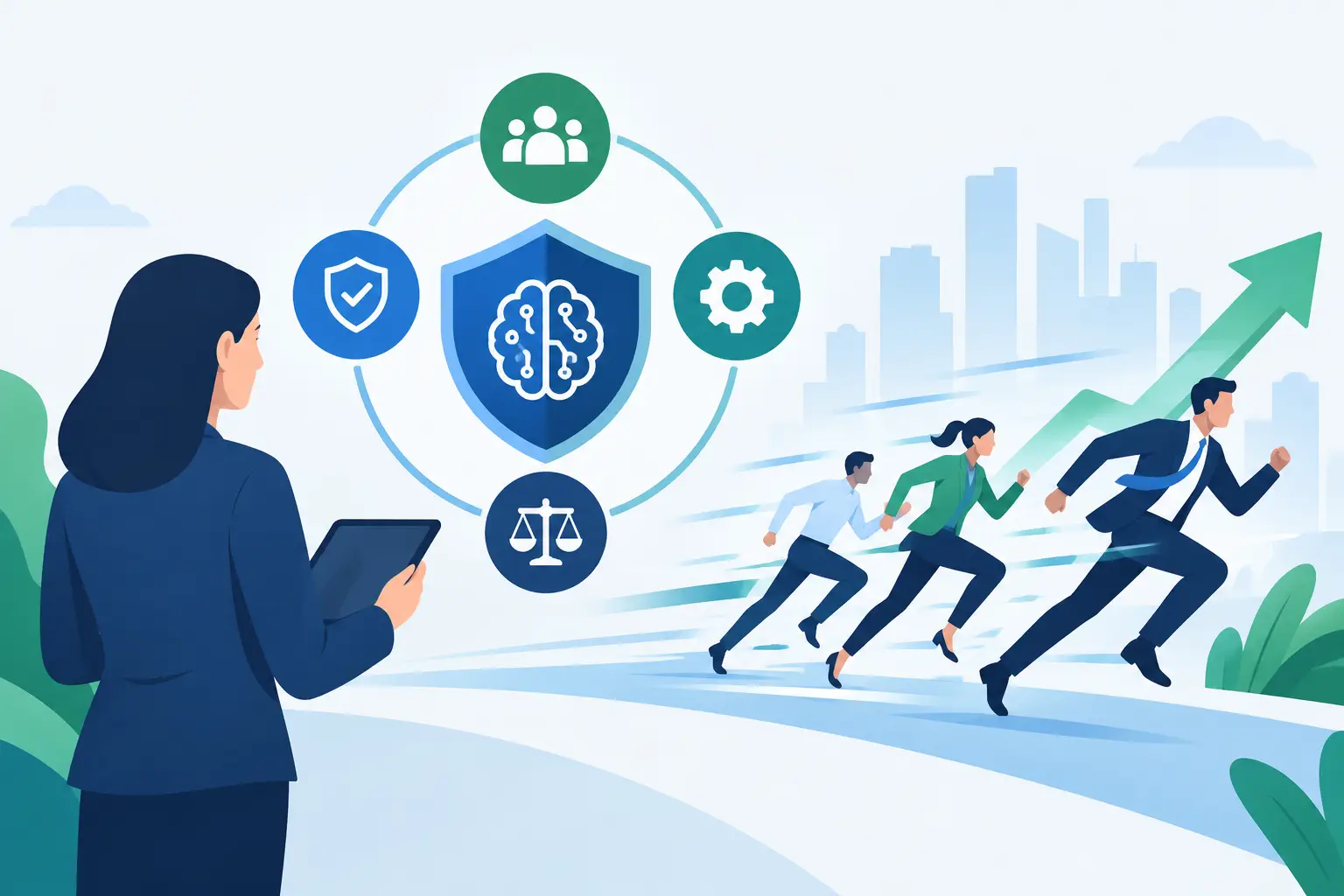
An operations leader discovers that several employees are already using public AI tools to summarize customer calls, draft proposals, and analyze internal documents. The productivity gains are real. So is the risk: nobody can say what data has been entered, where it is stored, who approved the use case, or how inaccurate output is being caught. AI governance is what turns that uncertain activity into a managed business capability.
The goal is not to create a policy binder that makes every useful idea wait six months for approval. It is to give teams clear boundaries, approved tools, accountable owners, and practical escalation paths so they can use AI with confidence. Done well, governance reduces hesitation and rework. It gives the business a way to move faster without treating privacy, security, or human judgment as afterthoughts.
What AI governance looks like in practice
AI governance is the set of decisions, controls, and responsibilities that guide how an organization selects, builds, deploys, and monitors AI systems. It covers generative AI tools, automated workflows, AI agents, predictive models, and internally developed applications.
For a Canadian business, this is not solely an IT task or a legal review. Operations understands the process being changed. Functional leaders define acceptable outcomes. IT and security assess access, integration, and data handling. Privacy and legal teams establish obligations and limits. Executives decide where the organization is willing to accept risk in exchange for speed, efficiency, or better service.
The strongest governance model makes these decisions visible before a tool is embedded in daily work. It answers practical questions such as: What business problem are we solving? What data will the system access? Can a person verify its output before it affects a customer, employee, or financial decision? Who owns the system after launch? What happens when it fails?
That last question matters. AI can produce a convincing answer that is incomplete, outdated, or simply wrong. Governance is not a claim that errors will never occur. It is a plan for detecting errors, limiting their impact, and improving the system over time.
Why informal AI use becomes expensive
Many organizations start with a reasonable instinct: let capable people experiment, then formalize what works. For low-risk learning, that can be useful. The problem begins when experimentation quietly becomes operational dependency.
A sales team may rely on a chatbot to prepare client-facing research. A service team may use an AI assistant to draft replies from account notes. A manager may use automated scoring to prioritize applications or cases. If those activities sit outside approved processes, the organization inherits risks without the controls that make AI dependable.
The cost is not limited to a possible privacy incident. Tool sprawl creates duplicate subscriptions, inconsistent quality, fragmented knowledge, and unclear support responsibilities. Teams also lose time correcting outputs because nobody has defined what good performance looks like. A useful prototype can become a frustrating workflow if it is never connected to the systems, permissions, and review steps people already use.
The alternative is practical over theoretical: govern the use case while building it. Define the guardrails early, test the workflow with real operating conditions, and put accountability in place before scaling.
A practical AI governance framework
The right framework depends on your industry, data sensitivity, regulatory obligations, and the consequence of a bad output. A marketing draft for an internal campaign does not require the same controls as an assistant that reviews patient information, recommends credit actions, or produces advice for clients.
Still, whether the goal is to adopt new tools, automate a workflow or instrument a custom app, most organizations can make progress in three steps: discover, build and adapt.
Discover the process and the risk
Start with the work, not the tool. Map the process from trigger to outcome and identify where employees spend time searching, reformatting, summarizing, routing, or entering the same information more than once. Then identify the data involved: public information, internal business data, confidential client material, personal information, or regulated records.
At this stage, assign a business owner for the use case and decide the level of human oversight required. A useful test is simple: if the AI gets this wrong, who is affected and how quickly can a person correct it?
Discovery should also establish success measures. These may include turnaround time, percentage of work automated, error rates, employee adoption, client response time, or capacity created. If a project cannot name the business result it intends to improve, it is not ready for deployment.
Build controls into the workflow
Governance becomes real when it is reflected in how the solution works. A policy that says "protect sensitive data" is not enough if a connected AI agent can retrieve every document in a shared drive.
Technical and operational controls may include approved AI providers, role-based access, data minimization, separate environments for testing, audit logs, retention settings, and permissions that mirror existing business roles. For systems that retrieve internal knowledge, the assistant should only access content the requesting user is already allowed to see.
Human approval should be designed around consequence, not habit. Requiring people to approve every low-value draft removes most of the benefit. Allowing fully automated action in a high-impact process can create unacceptable exposure. The practical middle ground is often review at defined decision points: before an external message is sent, before a record is changed, before money moves, or before an outcome affects an employee or customer.
Testing also needs to go beyond asking whether the tool produces an impressive answer. Test incomplete inputs, conflicting instructions, unusual edge cases, inaccurate source material, and attempts to access information outside a user's role. The question is not whether the AI performs well on a good day. It is whether the workflow behaves safely on a difficult one.
Adapt after deployment
Governance is ongoing operational work, not a launch checklist. Models change, vendors update terms, employees find new uses, and business processes evolve. Each change can affect risk and performance.
Create a lightweight process for employees to report poor outputs, privacy concerns, or ideas for improvement. Review usage and exceptions regularly. When the system changes materially - for example, it receives access to a new data source or moves from drafting to taking action - reassess the controls before expanding its authority.
Training is part of this stage. Employees need to know when AI is appropriate, what information they must not enter, how to validate output, and how to escalate a concern. Clear training reduces anxiety because it replaces vague warnings with usable judgment.
AI governance for Canadian data and privacy expectations
Canadian organizations need to consider privacy requirements early, particularly when AI handles personal information. PIPEDA may apply to commercial activities, while provincial privacy laws can also create obligations depending on the organization and jurisdiction. Quebec's Law 25, for example, has increased attention on privacy governance and assessments in applicable contexts.
The legal details require advice appropriate to your organization, but the operational questions are consistent. Know what data is collected, why it is needed, where it is processed, who can access it, how long it is retained, and how individuals can exercise applicable rights.
Data residency deserves particular care. Canadian hosting can be a meaningful requirement for some organizations and sectors, but residency alone does not resolve every concern. You still need to assess vendor access, subcontractors, encryption, contractual terms, retention, and the specific data flowing through the system. A tool can appear compliant at a high level while creating unnecessary exposure through a poorly designed integration.
For sensitive use cases, privacy, security, and business teams should work together during design rather than exchanging documents at the end. This avoids the familiar pattern of building something promising, then discovering it cannot be deployed as designed.
Measure whether governance is helping
Good governance should make delivery more predictable, not merely more controlled. Track evidence that the system is creating value and operating within acceptable boundaries. Four measures are especially useful:
- Adoption: Are employees using the approved workflow instead of returning to manual work or unapproved tools?
- Quality: How often do users correct, reject, or escalate AI output?
- Efficiency: Has the process reduced cycle time, repetitive work, or cost per transaction?
- Control performance: Are access reviews, audit logs, approval steps, and incident reporting working as intended?
These measures reveal trade-offs early. A system with excellent speed but poor adoption may not fit the workflow. A system with high accuracy but excessive review requirements may not justify its operating cost. The right answer is not always more automation. Sometimes the best outcome is a well-designed assistant that prepares the work while people retain the final decision.
The business case for clear guardrails
AI adoption often stalls because leaders see only two options: allow broad experimentation and accept the risk, or lock everything down and lose momentum. That is a false choice.
A focused governance approach gives employees a safe route to bring forward opportunities. It gives technology teams a repeatable way to evaluate requests. It gives executives evidence that AI investments are tied to measurable outcomes rather than scattered licences and informal workarounds.
Before purchasing another AI tool, choose one high-volume process where a better outcome would matter. Identify the data, the owner, the approval point, and the measure of success. That small piece of clarity is often where responsible AI progress starts.