Private Cloud Versus Public AI: Which Fits?
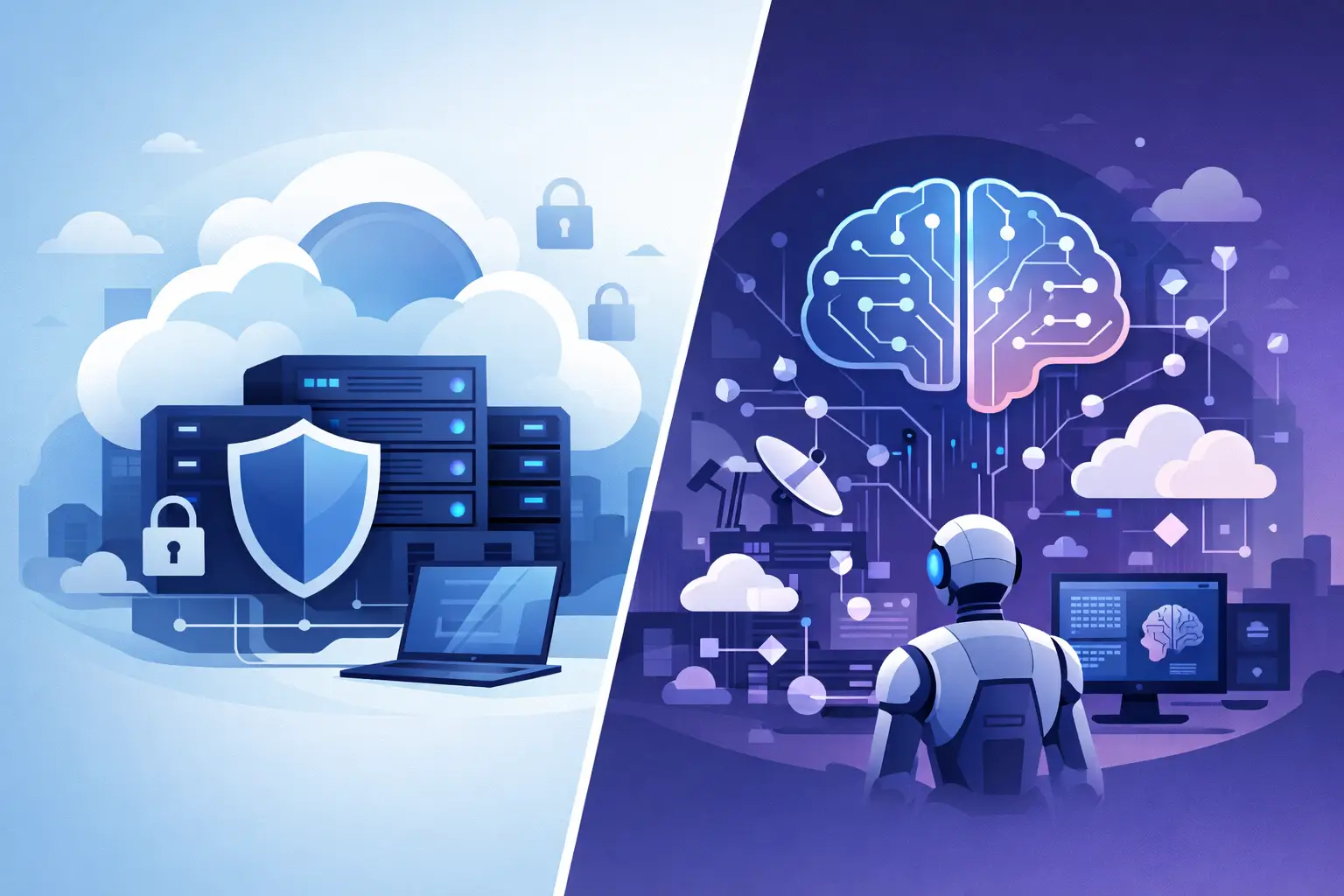
A claims team wants an AI assistant to summarize case files. A manufacturer wants technicians to search maintenance manuals from the plant floor. A law firm wants to draft first-pass research notes without exposing client matters. These are not abstract AI experiments. They are deployment decisions, and private cloud versus public AI is often the question that determines whether a useful pilot becomes a trusted operational tool.
The wrong framing is that one option is secure and the other is reckless. Both can support serious business use when designed properly. The real choice is about the sensitivity of the work, the controls required, the integrations involved, the expected volume, and how much responsibility your organization is prepared to own.
What private cloud and public AI actually mean
Public AI usually means consuming AI capabilities through a shared, provider-operated platform. Your team accesses a model through a browser, an application, or an API. The underlying infrastructure is operated at scale by the provider, which may offer enterprise controls such as encryption, tenant isolation, data-processing commitments, identity management, audit logging, and regional hosting options.
Private cloud AI usually means an environment dedicated to your organization or logically isolated under your control. It may run in a Canadian cloud region, a private virtual network, a dedicated tenant, or on infrastructure you manage. The model itself could be open source, commercially licensed, or accessed through a managed service with tighter network and data boundaries.
Those definitions matter because labels can hide meaningful differences. A public AI tool with enterprise settings and a carefully configured identity layer may be appropriate for sensitive internal work. A so-called private deployment can still be poorly secured if permissions are broad, data is retained unnecessarily, or logs are not governed. Architecture and operating discipline matter more than a marketing label.
Private cloud versus public AI: the business trade-off
Public AI is usually faster to test. A team can validate whether an assistant improves proposal drafting, customer service triage, knowledge retrieval, or document classification without first funding extensive infrastructure work. Providers also handle much of the model serving, updates, scaling, and reliability engineering. For a well-defined, lower-risk use case, that speed can be commercially valuable.
The trade-off is less direct control over the model environment and a greater need to examine contractual terms, data flows, retention settings, access permissions, and where processing occurs. If a tool is used casually by employees outside a governed workflow, the risk is not only privacy. It is inconsistent output, undocumented decisions, fragmented knowledge, and no clear owner when something goes wrong.
Private cloud deployments offer greater control over where data moves, who can access it, how long it is retained, and which systems the AI can reach. That can be decisive for organizations handling health information, legal records, financial data, regulated personal information, sensitive government material, or commercially confidential operational data.
The trade-off is cost and complexity. Private environments require thoughtful design, ongoing monitoring, patching, model evaluation, capacity planning, and support. If the use case is a simple internal writing aid, building a private stack may delay benefits without reducing a meaningful risk. Control is valuable when it protects a real requirement, not when it becomes an expensive substitute for a clear AI strategy.
Start with the workflow, not the hosting preference
Executives often start with a conclusion: “Our data cannot leave Canada,” or “We need the newest model available.” Both statements may be reasonable, but neither is a deployment plan. Begin by mapping the workflow that the AI will support.
Ask what information enters the system, what decisions the system influences, who reviews its output, and what happens after it produces an answer. An assistant that creates a first draft from approved public templates has a very different risk profile from one that reads patient notes, recommends credit actions, or triggers changes in an ERP system.
This assessment also prevents tool overload. Many organizations have employees using disconnected public tools for individual tasks while IT is asked to evaluate a separate enterprise platform. The result is duplicated spend, uneven governance, and no shared learning. A focused use case gives the organization a better basis for choosing an architecture.
A useful decision usually turns on four questions:
- Is the data personal, regulated, commercially sensitive, or subject to contractual restrictions?
- Does the use case need integration with internal systems such as a CRM, document repository, ERP, or case-management platform?
- Must processing and storage remain in Canada, and can the selected provider demonstrate the required configuration and commitments?
- Is the AI assisting a person, or is it taking action that can affect a customer, employee, financial outcome, or operational process?
If the answers point to high sensitivity, deep integration, strict data residency, or consequential actions, a private or tightly controlled enterprise deployment becomes more compelling. If the task is lower risk, limited in scope, and needs quick validation, a public enterprise AI service may be the sensible first move.
Data residency is not the same as privacy compliance
For Canadian organizations, data residency is a frequent and legitimate concern. But selecting a Canadian region is not a complete answer to PIPEDA obligations, provincial privacy requirements, contractual commitments, or sector-specific rules.
A responsible deployment considers the full data lifecycle: prompts, uploaded files, retrieval indexes, model outputs, telemetry, backups, application logs, support access, and connected systems. It also considers which users can see what. An AI assistant that runs in Canada but allows every employee to query confidential HR records is not a compliant design.
Public AI providers may offer no-training commitments for business data, configurable retention, and regional processing. These features can make public infrastructure viable for many use cases. They should be verified, documented, and configured rather than assumed. The exact service tier, region, account settings, and integration design all affect the outcome.
Private cloud can simplify control over these boundaries, especially when an organization needs network isolation, customer-managed keys, restricted administrative access, or a dedicated audit trail. It does not remove the need for governance. Someone still needs to define acceptable use, approve data sources, manage identities, test outputs, and respond to incidents.
Model quality and cost are not secondary issues
The strongest available public models can be attractive because they deliver excellent language, reasoning, and multimodal capability without a long implementation cycle. For some business problems, that quality is the difference between an assistant people adopt and one they ignore.
Private deployments can provide more predictable costs at sustained volume, avoid per-request exposure to a third-party model endpoint, and support specialized models closer to internal data. However, model quality varies widely. A smaller self-hosted model may be sufficient for extracting fields from invoices or routing service requests, but it may struggle with nuanced analysis, bilingual communication, or complex document reasoning.
Costs should be assessed across the workflow, not just by model token. Include implementation, integration, security review, data preparation, user training, monitoring, support, and the time employees save. A cheaper model that produces unreliable output can create more review work than it removes. A premium public model may be the lower-cost choice if it materially improves accuracy and adoption.
Human approval should shape the architecture
AI should remove repetitive work while preserving human judgment where judgment matters. This is particularly relevant when the system writes to a customer, changes a record, makes a recommendation, or produces content that could be treated as authoritative.
A practical design separates assistance from authority. The AI can retrieve relevant information, prepare a draft, flag exceptions, and suggest next steps. A designated employee reviews and approves the consequential action. This pattern works in either public or private environments, and it creates clearer accountability than an autonomous system deployed because autonomy sounded impressive.
The approval point should live inside the real workflow. If employees must copy content from one AI tool into three other systems and then seek approval by email, adoption will fade. Integration with existing permissions, document stores, service desks, and line-of-business applications is often more valuable than another standalone chatbot.
A practical path to the right deployment
The most effective organizations do not treat architecture as a one-time ideological decision. They use a staged approach: discover the process and risk boundaries, build a controlled solution around the highest-value use case, then adapt the operating model as usage and requirements become clearer.
During discovery, measure the current workload, identify the data involved, and define the outcome that would justify investment. During the build, configure access controls, source grounding, approval rules, and integrations before broad rollout. After deployment, review usage, output quality, exceptions, costs, and employee feedback. That is how governance becomes an operating practice rather than a policy document no one opens.
Adapting Services applies this approach because working software is the real test of an AI strategy. The goal is not to declare a winner in the private-cloud-versus-public-AI debate. It is to give your team a dependable capability that fits the risk, the workflow, and the business case.
The helpful next question is not “Which platform is best?” It is “Which repetitive, high-value decision or process should our people be able to handle better within the next 90 days?” The answer will usually point to the right level of control, and to an AI deployment worth maintaining.